How to Bloom in a Time of Doom
What if there is another path? For you, for those you care about, and for the world?
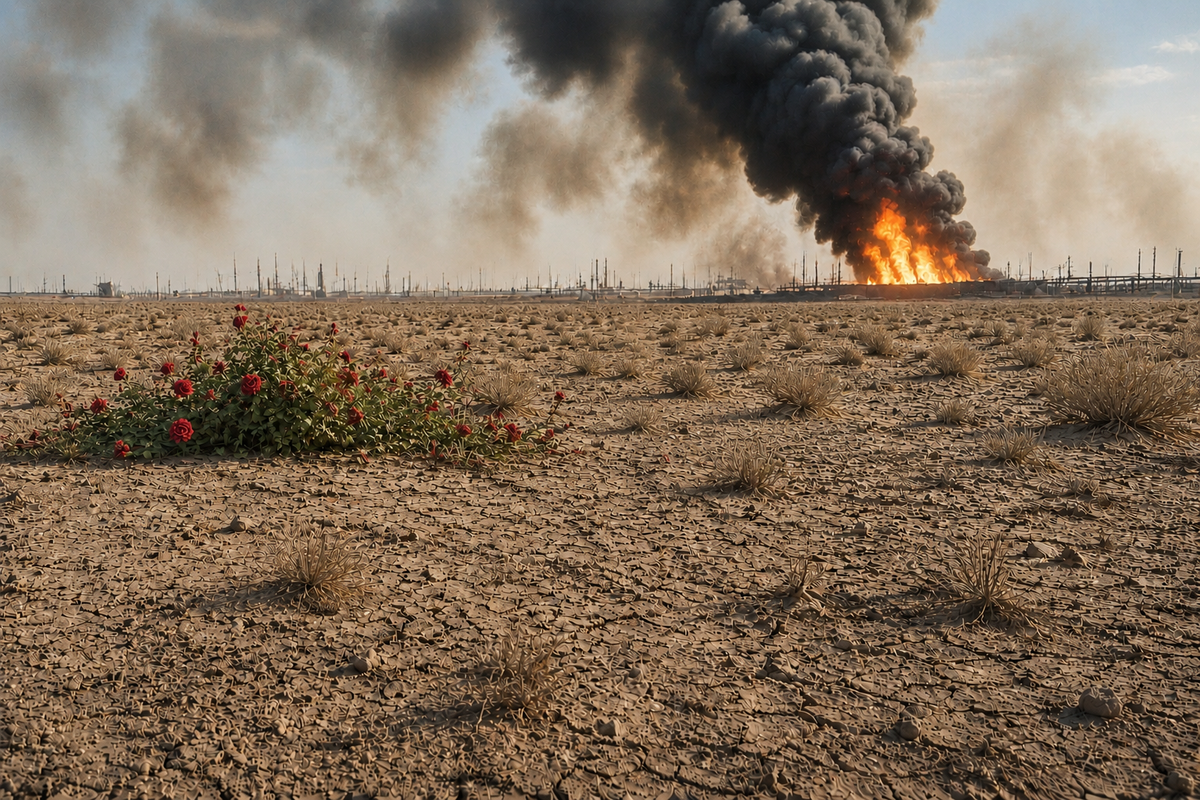
Everything around you tells you that it has all horribly gone wrong.
The world is on fire. The rich are getting richer; the poor are getting poorer. Nothing is in your control, and those in control have nothing to offer you.
Headlines of another war. Dead children in your feeds. The world order falling. The system of money collapsing. No one having sex. No one having babies. You are being left behind. You might as well give in and then give up. Burn it all down.
Meanwhile, your life is at the mercy of new machines. You spend more time talking to a chatbot than your friends.
Doom is upon you, is upon all of us, and there is nothing you can do.
But what if this is wrong? What if there is another path? For you, for those you care about, and for the world?
Nostalgia masks the reality of the past. When was the better time? Was it a century ago, in the Roaring 20s…just ahead of 1929 and the onset of the Great Depression? Soon after, between 60 and 100 million souls perished in World War II.
The ‘rules-based order’ began 80 years ago. America saw a venerated baby boom and the emergence of the idyllic American dream of white picket fences. Schools desegregated, and the dueling superpowers went to space, then to the moon. Yet, it was also the beginning of the Doomsday Clock, with the specter of nuclear war hanging as a shadow over everyone.
Population and climate alarmists took over the narrative of an apocalypse by the 1960s and 70s. The world was going to run out of food, and soon. The Vietnam War was the harbinger of death for young people on all sides. And the leading political lights from JFK to RFK, MLK to Malcolm, were extinguished.
The Middle East was no better, helping ignite a global inflationary crisis, with interest rates soaring to 20% in Western countries. War and revolution became the norm, leading to hundreds of thousands of deaths. Lebanon in civil strife. Iran and Iraq in a decade of conflict. Afghanistan under Soviet bombardment.
Were the 1990s the period of emancipation? If you read the headlines then, you might fall into an even deeper malaise than you do today. Television brainwashing children. Drugs on the rise. Endless civil wars and genocides, from Bosnia to Somalia to Rwanda.
The 2000s fared no better. First came the 9/11 attacks and the War on Terror, followed by the Global Financial Crisis. This all contributed to the opioid crisis, which lowered life expectancy levels in America for the first time in a century.
Then, the Arab Spring reversed. Politics of polarization from left and right. Pandemics and lockdowns. War, then more war. Inequality, then more inequality, which brings us to today.
As you can see, the story always goes from bad to worse.
The world has always been a hard place. Still, we are given other narratives. The Better Angels of Our Nature. Factfulness. Abundance. Charts show us that life expectancy has increased, income levels have risen, and health standards have improved.
It is true. Through it all, through all the doom, many survived and thrived. Amidst war there was love. One generation fled poverty, and the next one found prosperity. Technology that could destroy a million lives could just as easily power the future of millions more.
So you should be happy. Everything is just fine. There is nothing to see here. Does that satisfy you?
In our world of rationality, we can be quick to use ‘facts’ to overwhelm feelings. Intelligence to dominate intuition. But does that make it true?
After a century of exponential progress, technological revolutions and infinite money, we are not much happier. If anything, we are more lost than ever, whether as individuals or as countries. Poverty abounds even as trillionaires rise in the public square. Evil still lurks without guardrails, ready to pounce, as we have seen in countless wars. Amidst material gains, an acute spiritual standoff looms even if we can’t fully describe it.
Yet, there is something else unique about today: the power of unprecedented possibility rests in the palm of our hand. It gives us the ability to change our circumstances in ways never seen before.
There has never been a better time to choose your own destiny. You are equipped with incredible tools. You can talk to anyone at any time, anywhere. The world’s knowledge is at your fingertips. You can look up anything about any topic.
Do you want to learn a skill? You can take a course for free. Do you want to build a business? You can hire talent or even create virtual talent. Do you want to be an artist? You can be the director of your own film or the composer of a new song.
Nothing stops anyone from building today. There are limits, however. While the choice is easy, the path is not. It is a struggle, for households or governments. You must be cognizant of when you threaten power. You must understand the limitations of your resources. And you must be aware of the trade-offs of any path.
Politics is still all-consuming and zero-sum. Certainly, things need to change. But the only thing that is constant is that everything changes – and paradoxically that nothing ever changes. Lamenting that the world is the world and has always been the world is, in many ways, just a state of mind.
To doom or to bloom, the choice is yours.