
It Is Time for a Sovereign Summit on Iran
A meeting of the three sovereigns – Putin, Erdogan, and Trump – may be the only way forward.
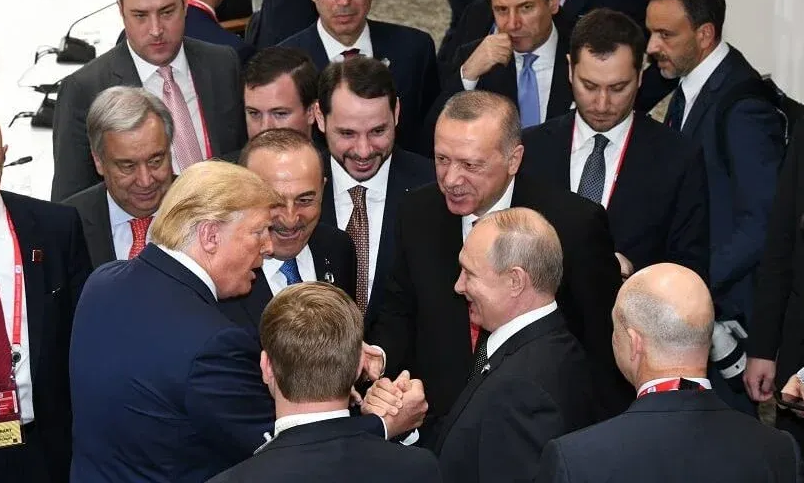
How a Trump–Putin–Erdogan Meeting Could Be the Way Forward
“Iranian attacks have knocked out 17% of Qatar’s liquefied natural gas (LNG) export capacity, causing an estimated $20 billion in lost annual revenue and threatening supplies to Europe and Asia.”
- Saad al Kaabi, CEO, Qatar Energy (Reuters)
With the global economy in peril, drastic intervention is needed. Current approaches to diplomacy are failing. In an era of personalized geopolitics, this must happen at the sovereign level, involving leaders who preside over real, not imagined, sovereignty.
Iran, Israel, and America are on an immovable war path. A visit by the Japanese Prime Minister, a call from the French President, or a statement by the King of Jordan would fall by the wayside. There are likely only two leaders who have the ear of President Donald Trump who can also offer an alternative path:
President Vladimir Putin of Russia and President Tayyip Erdogan of Turkey.
A meeting of the three sovereigns – Putin, Erdogan, and Trump – may be the only way forward.
Sovereignty, Power, and Tehran
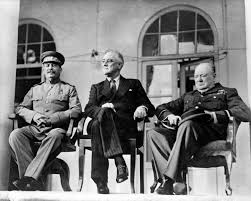
In 1943, the three leaders of the soon-to-be remade World War II assembled in Tehran. Joseph Stalin, Franklin D. Roosevelt, and Winston Churchill represented the USSR, the United States, and the British Empire. As the three sovereigns sat and made a deal that would reshape not only the geography of the globe, they knew that the decisions made at the table would be backed by their sovereign power.
Today, few countries possess intrinsic sovereignty. Where it exists, it is largely defined by two traits: the existence of nuclear weapons and indigenous, if not autarkic, capabilities. Pakistan, the United Kingdom, and France, while possessing nuclear weapons, are integrated into the American security and financial apparatus and cannot be said to be fully sovereign.
Outside of America, there appear to be only four independent sovereignties: China, Russia, Iran, and North Korea. Israel and Turkey are trying to join this group and hence are already caught in a forthcoming rivalry. Of course, others, both within and outside the American order, may seek to assert and test their sovereignty in the coming years.
A Reset with Russia
For two decades after the Cold War, the United States pursued a policy of bringing Russia into its orbit. At the tail end of the Bush administration, the U.S. first arranged for anti-ballistic missiles in Poland and then, in 2008, pushed for Georgia and Ukraine to have a path to NATO membership. A few months later, Russia invaded Georgia, which led to American sanctions.
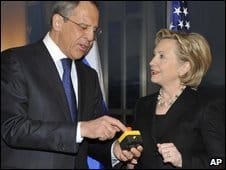
On March 6, 2009, then U.S. Secretary of State Hilary Clinton presented Russian Foreign Minister Sergey Lavrov with a toy reset button. Written boldly was the word peregruzka. Lavrov pointed out that the translator had made a mistake; peregruzka did not mean reset, but reloading or overcharging.
American policies in Libya and Syria only further antagonized Moscow. Yet, even after the invasion of Crimea, America continued to engage Russia in the JCPOA negotiations with Iran. The approach to international relations in a changing world cannot be a permanent confrontation between rising or rival powers.
There will be no perestroika in Russia. But that also does not mean there needs to be peregruzka.
A Grand Bargain
The Middle East has been defined by a Turko-Russo-Persian relationship for half a millennium. In modern times, the Caucasus and the Caspian Sea have seen Turkey, Russia, and Iran alternately assert their interests. Russia and Turkey are accustomed to responding to threats or expansionism from Iran.
In the current threat environment, Russian and Turkish forces can contribute to maritime patrols to secure the waters around Iran. They could also support in other ways. Putin offered solutions on the enrichment issue to Trump at the outset of this conflict. Turkey can serve as a financial gateway for Iran, an alternative to the GCC, where acrimony is likely to persist for a while.
Presidents Erdogan and Putin would have demands of their own. For Turkey, it will likely want America’s formal blessing for its zone of influence extending to Syria and into the Caucasus, as well as for its sovereign military development. Russian demands are more expansive, but they have already been considered at length by the White House.
President Trump has indicated a desire to return to the 2007 American stance: the removal of anti-ballistic missiles on Russia’s borders, the cancellation of NATO pathways for remaining border states, and the demarcation of a demilitarized buffer zone in Ukraine. With China as America’s principal geostrategic rival, a détente with Russia would mirror the position that Kissinger took vis-à-vis Mao’s China.
Such a geostrategic arrangement could be beneficial for Europe, which now finds itself caught between dominant American and Russian sovereignties and its own declining independence. The end of both the Iran and Ukraine conflicts would lead to energy abundance for the continent.
The Domestic Dynamic
There would be a lot of resistance in Washington D.C., from Capitol Hill, the neoconservative corners of the GOP, and, of course, from the Israel lobby, involving Turkey and Russia. Yet, if anyone has ‘political credit’ with hawks in Washington, it is President Trump. He went further than any previous president and authorized the assassination of the Supreme Leader of Iran.
The president can decide the path forward. Despite misgivings from some officials, he has already engaged Russia and Turkey in discussions on geopolitical dealmaking. Bringing Presidents Erdogan and Putin to the table also provides him with a balancing act against the very interests that might militate against stopping the war.
The thread through the needle is: what specifically does the United States have to give up in Ukraine and Europe to bring Russia to the table and strike a grand bargain? There are still devils in these details.
Wounded Lion
While Iran has suffered heavy strikes for three weeks and the repeated decapitation of its leadership, it not only has survived but it has struck back, with precision, targets across the Middle East. Iran has demonstrated sovereign strength. In that sense, it may have evaded wholesale regime change.
Regardless, every day this continues, Iran is losing allies due to attacks on global energy infrastructure. Its own capabilities are also now heavily degraded. A new geopolitical dynamic could be the opening required that starts to create an offramp for Iran.
Russia and Turkey would not join the American military campaign directly, but that would not allay Iran’s concerns. Regardless, it would have greater trust in those two actors than in the Israeli-American alliance. Iran is also less likely to attack naval ships from Russia and Turkey that would be protecting the Strait of Hormuz. And even a wounded lion would welcome time to recover.
What price it is willing to pay for that recovery can only be settled at the sovereign table.
The proposal here is bold. But that is where the world’s geopolitical reality is already headed, beyond the current conflict. It is time for a new approach as the war reaches a dangerous escalation point.
It is time for a Trump-Putin-Erdogan summit. Before it is too late.
Taufiq Rahim is a geopolitical strategist based in New York.